

Neural communication and synaptic function
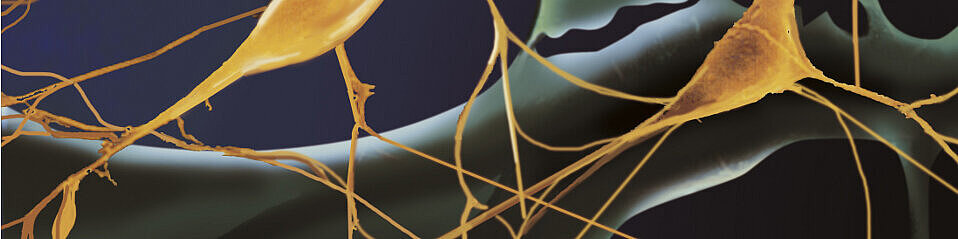
Brain function relies on the communication via synapses that connect individual neurons to large and sophisticated networks. Synapses are specialised zones of contact, consisting of a presynaptic terminal formed by the neuron transmitting the information, a synaptic cleft separating the cells, and a postsynaptic region of the neuron that receives the information. In addition, synapses are contacted by astrocytes that support and modulate the signal transfer. Even minor dysfunction of this delicately tuned system ultimately leads to neurological deficits and brain disease.
Researchers at the HHU investigate the mechanisms of formation, maintenance and both structural and functional plasticity of synapses and neuronal networks under physiological and pathophysiological conditions. These topics are experimentally addressed in various model systems ranging from fruit flies to rodents to man. A wide range of methodological approaches including molecular biology, biochemistry and proteomics, single molecule and high-resolution microscopy, electrophysiology and behavioural studies enable the investigation of relevant questions in synapse physiology/pathophysiology from different but complementary points of view. Dynamic structural and functional connectivity patterns are analyzed using non-invasive neuroimaging and neurophysiological methods to reveal mechanisms underlying sensorimotor and cognitive functions.
PIs
The fruit fly Drosophila melanogaster is used to study cellular and molecular aspects of neural and synapse development. Hermann Aberle combines the power of Drosophila genetics with single synapse resolution imaging to characterise molecular mechanisms regulating structural plasticity of synaptic terminals, synaptic growth and degeneration (Koch, Neuron 2008; Banovic, Neuron 2010).
The research of Kurt Gottmann is focused on transsynaptic adhesion molecules that are vital for the formation of synapses (Gottmann, J Neurosci Res 2008; Stan, PNAS 2010). Synaptic adhesion molecules may also be critically involved in synapse loss in neurodegenerative diseases and the Gottmann group has started to study their contribution to the molecular mechanisms of synaptotoxicity of Aβ oligomers.
Information processing in neurons and at synapses relies on ion channels, protein complexes assembled from pore-forming alpha-subunits and auxiliary beta-subunits, which are the research focus of Nikolaj Klöcker. Using a multimodal approach from proteomics to cell biology and electrophysiology, the lab analyses the molecular composition of ion channel protein complexes and determines their functional characteristics (Zolles, Neuron 2009; Schwenk, Science 2009; Schwenk, Neuron 2012).
The group of Alessandro Prigione investigates the metabolic aspects of neuronal communication using human neurons and glia derived from induced pluripotent stem cells (iPSCs). Using these models, the lab aims to harness the neuronal metabolic impairment occurring in the context of pediatric mitochondrial diseases to identify innovative treatment strategies (Lorenz et al, Cell Stem Cell 2017; Lorenz et al, Curr Op Cell Biol 2017).
Applying high-resolution imaging techniques, such as live-cell multi-photon-microscopy combined with whole-cell patch-clamp, Christine R. Rose studies the functional roles of astrocytes at synapses and their contribution to brain disease (Deitmer & Rose, Brain Res Rev 2010). A main focus is on sodium-dependent glial glutamate uptake (Filosa, Nat Neurosci 2009; Kelly and Rose, J Neurochem 2010; Langer et al., Glia 2011).
Olga Sergeeva investigates the structure-function relationship of ion channels gated by the inhibitory transmitter GABA using electrophysiological and molecular techniques (Sergeeva, J Neurosci 2005; Sergeeva, J Biol Chem 2010). Moreover, she studies hypothalamic sleep-wake regulation (Parmentier, J Neurosci 2009) and, together with H. Haas, investigates hypothalamic waking transmitters (Haas, Physiol Rev 2008; Yanovsky J Physiol 2011).
The research focus of Charlotte von Gall is the mammalian circadian system and the suprachiasmatic nucleus (SCN) as the endogenous rhythm generator. Pre- and postsynaptic elements and synaptic transmission properties of SCN neurons with targeted deletions of different clock genes are analysed by neuroanatomical methods, including electron microscopy and immunohistochemistry, differential proteome and functional analyses (Pfeffer, J Neuroscience 2009; Christ, Neuroscience 2010).